
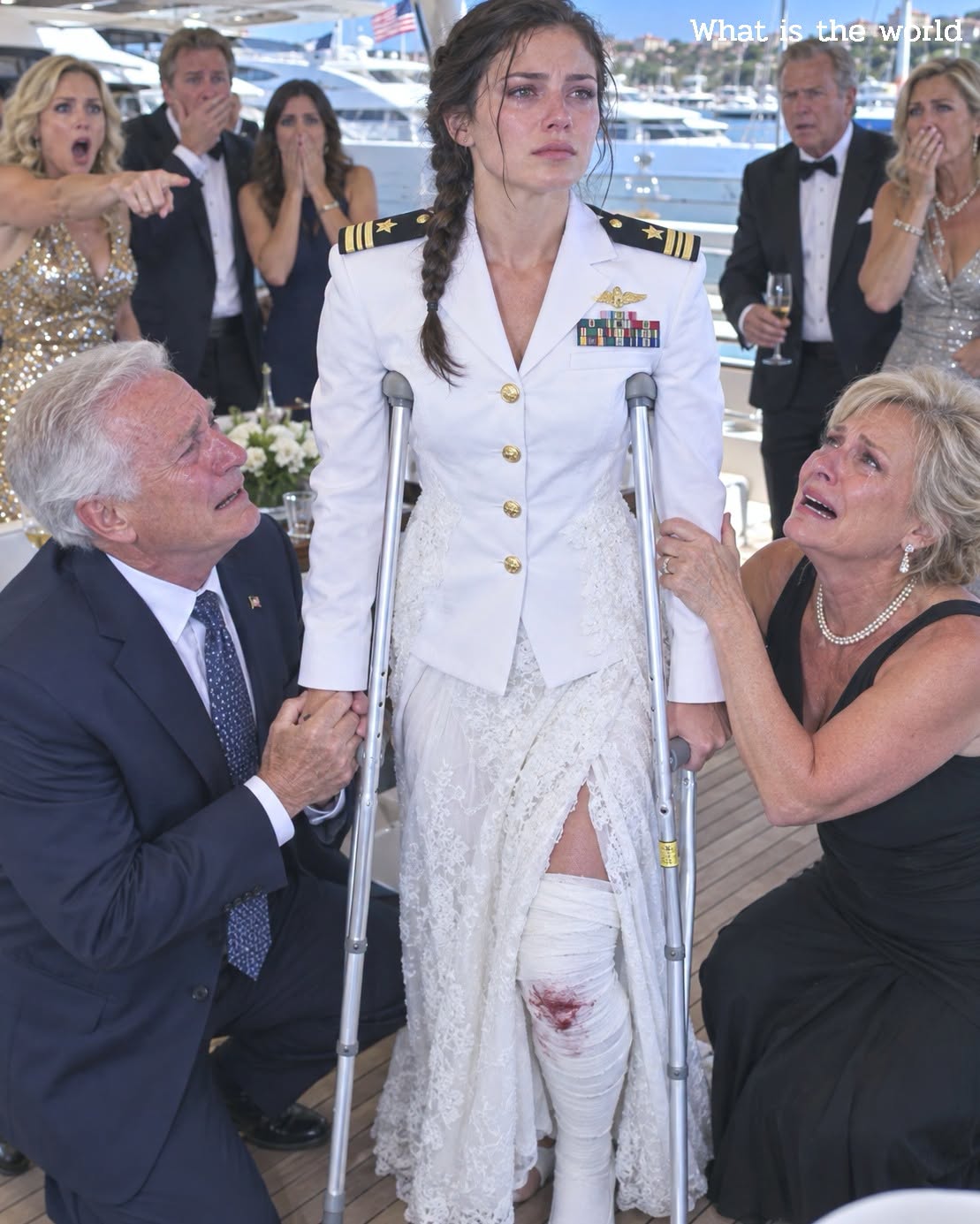
My parents bought my sister a $150,000 yacht while I sat in a military clinic, begging them for $5,000 to save my leg.
They celebrated with champagne while I faced the possibility that I might never walk properly again. To them, my injury was an inconvenience, my military service was nothing to celebrate, and my pain was less important than my sister’s latest luxury purchase.
They believed I would always be the daughter they could ignore, humiliate, and abandon without consequences.
They were wrong.
They had no idea that my younger brother’s heartbreaking sacrifice would lead me to a winning lottery ticket, a hidden inheritance, and a truth that would destroy the perfect family image they had spent years protecting.
But the greatest surprise was not the money.
It was discovering why my grandfather had trusted me with a secret he had never dared to reveal while he was alive.
The Phone Call That Changed Everything
I was still wearing my combat fatigues when I called my father from a military clinic outside San Diego.
My knee was swollen beneath a heavy brace, and I gripped the edge of the examination table while the doctor explained my options.
The damage was serious. If I did not receive the recommended surgery by Thursday, the injury could become permanent.
Permanent.
The word echoed in my head long after the doctor finished speaking.
I had served my country, endured exhausting deployments, and learned to keep moving even when every part of me wanted to give up. Asking my family for help was the last thing I wanted to do.
But I needed $5,000.
I had already exhausted most of my savings, and the medical expenses were more than I could manage on my own.
When my father finally answered, I tried to keep my voice steady.
“Dad, I need to talk to you. The doctor says I need surgery immediately. I need five thousand dollars. I wouldn’t ask if it weren’t serious.”
For several seconds, I heard nothing but background noise.
Music. Laughter. Glasses clinking.
Then a champagne cork popped.
My father sighed.
“Emily, this is really bad timing. We just closed on Madison’s yacht.”
I stared at the white wall in front of me.
“A yacht?”
My mother laughed somewhere in the background.
“Tell her not to be dramatic!”
Then my older sister grabbed the phone.
“Emily, seriously?” Madison snapped. “Can you stop ruining my party? Take some painkillers and deal with it.”
I waited for someone to ask how badly I was hurt.
I waited for my father to reconsider.
I waited for my mother to tell Madison to stop speaking to me that way.
Nobody did.
I had spent years hoping that if I worked hard enough, served honorably enough, and asked for little enough, my family would eventually treat me as though I mattered.
That afternoon, I finally understood how foolish that hope had been.
“Forget it,” I whispered.
I ended the call.
Two days later, someone knocked on my apartment door.
It was my younger brother, Jake.
At twenty, he was still trying to figure out his future. He had grease beneath his fingernails, exhaustion in his eyes, and a folded stack of cash in his hand.
“I’m sorry,” he said.
I looked at the money.
“What is this?”
“Eight hundred and forty dollars. It’s not enough, but it’s what I could get.”
My throat tightened.
“Jake, where did you get it?”
He looked down.
“I sold Grandpa’s tools.”
I couldn’t speak.
Our grandfather had left Jake his collection of Snap-on tools, carefully gathered over decades of working as a mechanic. Jake had dreamed of opening his own repair shop one day, and those tools were supposed to be the beginning of that dream.
He had sold them to help me.
He had given up something precious because our parents had refused to give me even a fraction of what they had spent on Madison’s yacht.
Then Jake placed a lottery ticket on top of the money.
“I bought it with the change,” he said quietly. “Maybe we’re due for a miracle.”
I hugged him, trying not to cry.
The following morning, I checked the winning numbers.
Once.
Twice.
Then a third time.
Every number matched.
The jackpot was $2.4 million.
I sat motionless, staring at the screen while Jake slept on my couch, exhausted from worrying about me.
I didn’t scream or celebrate. I didn’t immediately call my parents to tell them what they had missed.
Instead, I looked at my brother and thought about what he had sacrificed when he believed there was no hope.
The money could change my life.
But before I claimed it, I needed to understand something.
Why had my family treated me as though I had never belonged to them?
And why had my grandfather always seemed to know there was more to our family than anyone was willing to admit?
The Lawyer and the Secret Inheritance
I contacted a reputable law firm in downtown Los Angeles and asked to speak with an attorney experienced in trusts, estates, and financial investigations.
The lawyer assigned to my case was Mr. Callahan.
He listened carefully as I explained my medical emergency, the lottery win, and my family’s financial circumstances. I told him I wanted to claim my winnings through an appropriate legal structure to protect my privacy, and I wanted to investigate whether my parents had mishandled any money belonging to me.
He raised an eyebrow.
“You suspect financial misconduct?”
“I suspect my family has been lying to me for years.”
I explained how my grandfather had recently died, leaving behind a workshop, some land, and a lifetime of memories. My parents had taken charge of his affairs almost immediately, and I had barely been informed about anything before they began arranging the sale of his belongings.
Callahan agreed to examine the available estate records.
Before he could begin, my phone rang.
It was Jake.
“Emily, I found something at Grandpa’s house.”
“What?”
“A key. It was taped underneath the bottom drawer of his workbench. There’s also a letter with your name on it.”
My heart began pounding.
“What does the letter say?”
“I haven’t read everything. But Grandpa wrote that if you ever started asking questions, I had to give it to you before Mom and Dad found it.”
Callahan stopped writing.
“Where is your brother?” he asked.
I told him Jake was at our grandfather’s old property.
“Tell him not to confront anyone,” Callahan said. “If your parents suspect that documents are missing, they may try to remove anything else they believe could expose them.”
I called Jake back, but he whispered that a black SUV had arrived outside the house.
Then I heard my father’s voice in the background.
“The tools are gone!”
My mother answered sharply.
“He couldn’t have known. He was old and confused.”
My father lowered his voice, but I could still hear him.
“He knew enough to hide things.”
The call ended abruptly.
Callahan immediately contacted the appropriate authorities to request a welfare check. We drove to the property, where a police officer confirmed that someone had apparently left through a window near the workshop.
Jake was nowhere to be found.
Inside the shed, I discovered a torn piece of paper beneath the workbench. The handwriting was unmistakably my grandfather’s.
It contained only one sentence:
For the granddaughter they tried to erase.
I read it several times.
The granddaughter they tried to erase.
What did he mean?
Before I could ask Callahan, a white car pulled into the driveway.
Madison stepped out.
She was still wearing the silver dress from her yacht party, but her makeup was smudged and her face was pale.
“Emily,” she said urgently. “I need to tell you something before Mom and Dad find out.”
For once, she wasn’t angry with me.
She was frightened.
The Truth About My Family
Madison told us that our grandfather had visited her shortly before his death.
He had warned her to stop signing financial documents without reading them. He had also asked her whether she understood why our parents had established a company in her name.
The company was called Whitmore Horizons.
Madison had signed paperwork when she turned eighteen, believing it was a routine business arrangement that would help her parents manage family investments.
“I never questioned Dad,” she admitted. “He always told me he was protecting me.”
Callahan asked whether she had copies of the documents.
She shook her head.
Then she looked at me.
“Grandpa said there was a trust. He said it was supposed to belong to you.”
My mother immediately interrupted.
“That’s enough.”
Madison ignored her.
“He said your biological mother created it.”
I felt the ground shift beneath me.
“My biological mother?”
My father had always told me that my mother was the woman who raised me. I had never been given a reason to question that story.
Now my parents stood before me, unable to hide their fear.
Finally, my father admitted the truth.
“My sister Claire was your biological mother,” he said. “She died when you were a baby. Your grandfather insisted that we raise you.”
I stared at him.
My biological mother had been my father’s sister?
Why had nobody told me?
My mother crossed her arms.
“Claire left behind problems, Emily. Your grandfather made us take responsibility for them.”
“What problems?”
Neither of them answered.
Callahan stepped forward.
“If there is a trust established in Emily’s name, we need the original documents. Until we see them, nobody should make assumptions about who owns what.”
My father looked furious.
Then a voice came from the darkness beyond the workshop.
“It’s about time someone said that.”
Jake emerged from behind an old oak tree, covered in dirt but unharmed.
I ran to him and wrapped my arms around him.
He was shaking, but he smiled.
“I got away through the back window,” he whispered. “And I have what Grandpa left us.”
He held up a small black flash drive and a key.
The key, he explained, had been hidden with a letter that instructed him to retrieve a sealed box from a bank. The flash drive contained copies of documents and a video Grandpa had recorded before his death.
We took everything to Callahan’s office.
At two in the morning, he opened the video file.
My grandfather appeared on the screen wearing his familiar brown cardigan.
For a moment, I could barely breathe.
“Emily,” he began, “if you’re watching this, then I wasn’t able to explain everything while I was alive. I’m sorry, sweetheart. I thought I had more time.”
Tears filled my eyes.
He explained that Claire had created a trust for me using money from her business, life insurance, and inherited property. He had served as trustee and was responsible for protecting the assets until I reached the age specified in the trust documents.
I had recently turned twenty-five.
The trust was supposed to provide for my future.
But my grandfather had discovered that my parents were attempting to gain control of the assets through questionable paperwork and unauthorized transfers.
He had confronted them and demanded that they stop.
“They promised to repay what they had taken,” he said on the recording. “I wanted to believe my own son. That was my mistake.”
Callahan paused the video.
“Unauthorized transfers and forged documents could be extremely serious,” he said. “We need to verify every transaction.”
My grandfather had left more than memories.
He had left evidence.
The Million-Dollar Betrayal
The next morning, Callahan began examining the financial records.
What he discovered was worse than I had imagined.
The trust held approximately $1.8 million, along with property that included my grandfather’s workshop and a valuable waterfront lot.
My parents had never been authorized to control those assets.
Yet the records suggested that more than a million dollars had been transferred through companies with questionable business purposes.
Some payments appeared to cover personal debts. Others were connected to luxury purchases and expenses associated with Madison’s lifestyle.
My father had also been trying to sell the waterfront property.
If he succeeded, the proceeds might have disappeared before anyone discovered that the property belonged to the trust.
Callahan filed the necessary legal applications to preserve the assets and challenge the disputed transactions.
Within days, several accounts were frozen pending review.
The yacht financing was also placed under scrutiny because some of the paperwork appeared to rely on assets that my father had no authority to use.
Then Madison called me.
“What have you done?” she demanded.
“I’m trying to find out where Grandpa’s money went.”
“Dad says you’re destroying the family.”
I almost laughed.
“Madison, I asked him for five thousand dollars to save my leg. He refused while celebrating a yacht that may have been financed using money that wasn’t his.”
Silence followed.
Then her voice changed.
“My name is on some of those documents.”
I sat upright.
“What documents?”
“The yacht financing papers. Dad said they were routine. He said signing them would help my credit.”
“Did you read them?”
“No.”
For the first time, Madison seemed to understand that her privileged life had come with responsibilities she had never considered.
I told her to seek independent legal advice immediately.
She initially resisted, but a few days later, she hired an attorney of her own.
Her lawyer contacted Callahan and confirmed that Madison was prepared to cooperate with the investigation if her signature had been used improperly.
I didn’t suddenly forgive my sister.
She had mocked me when I was injured. She had treated my suffering as an interruption to her celebration.
But I began to understand that our parents had built a world in which Madison received everything she wanted while remaining dependent on their approval.
She had been favored, but she had also been manipulated.
That didn’t excuse her behavior.
It did, however, leave room for something I hadn’t expected.
The possibility that she might change.
The Yacht Party They Would Never Forget
A week later, Madison held another event aboard the yacht.
My parents had invited business associates, friends, distant relatives, and anyone else who might reinforce the image of a wealthy, successful family.
They wanted everyone to believe nothing had changed.
I decided to attend.
My leg was still recovering from surgery, but the procedure had gone well. I wore a black dress, carried my crutches, and arrived with Jake and Callahan.
When my father saw me, his smile faltered.
“Emily,” he said, pretending to be delighted. “What a surprise.”
“I thought I’d come see the yacht.”
My mother leaned toward me.
“You shouldn’t be here.”
“Why not?”
“Because this is a family event.”
I looked at her.
“You stopped treating me like family when I called you from that clinic.”
Before she could answer, Madison approached.
“You brought lawyers to my party?”
“No,” I replied. “Your father brought questionable financial documents to yours.”
Her expression tightened.
The guests gathered for a toast. My father raised his glass and began talking about success, family, and the bright future he had supposedly built for us.
Then Callahan stepped forward.
“Martin Harper,” he said calmly, “you have been formally served with legal documents concerning the disputed trust assets.”
A process server handed my father an envelope.
The crowd fell silent.
My mother looked furious.
“This is completely inappropriate.”
Callahan remained composed.
“What’s inappropriate is the alleged misuse of funds belonging to a trust you were not authorized to control.”
The word misuse spread through the gathering in a wave of whispers.
Madison turned toward our father.
“Tell me the yacht wasn’t financed with money that didn’t belong to you.”
He stared at her.
“Not now, Madison.”
“Tell me!”
He didn’t answer.
Her face crumpled.
I stepped forward, leaning on my crutches.
“For years, I thought I was the problem,” I told the guests. “I thought I was too serious, too stubborn, too inconvenient. But when I needed help, my family refused to give me five thousand dollars for surgery while celebrating a $150,000 yacht.”
My mother whispered my name, begging me to stop.
I continued.
“My younger brother sold the tools our grandfather left him so I could afford my treatment. He gave up something that mattered to him because he understood something our parents forgot: family is supposed to care when someone is suffering.”
Jake looked down, embarrassed by the attention.
I turned toward my father.
“You thought money made you powerful. You thought people would believe your image instead of looking at the evidence. But the records are being examined, and the truth is no longer yours to control.”
Callahan explained that the court had taken steps to preserve the disputed assets while the investigation continued.
Madison set down her champagne glass.
Then a bank representative approached Callahan with a sealed envelope.
The envelope had been recovered from the safe-deposit box identified by my grandfather’s key.
It contained original trust documents, letters from Claire, and another letter addressed specifically to Madison.
She opened it with trembling hands.
Grandpa’s message was short.
He told her that she had been given gifts, applause, and opportunities, but that none of those things could replace character.
He had not excluded her from the trust because he hated her. He had wanted her to learn that being adored was not the same as being loved.
He ended with a challenge.
If your parents ever use your name or your signature for their own gain, stand up. Not because standing is easy, but because crawling will cost you more.
Madison lowered the letter.
For the first time, she did not defend our parents.
She stood beside me.
And that small decision changed the course of everything that followed.
The Sister Who Finally Said No
The investigation continued for several months.
My parents faced legal proceedings over the disputed trust transfers and financial documents. The records were examined, the property was protected, and the court reviewed the evidence.
Madison cooperated with investigators through her own lawyer. She provided documents and explained what she had been told about the companies and financing arrangements.
Our family did not suddenly become loving.
There were arguments, accusations, and painful conversations. Some relatives blamed me for exposing the situation, while others quietly admitted that they had always suspected something was wrong.
My mother even posted a message online suggesting that I had become greedy and turned against my family for money.
I refused to respond.
I knew what had happened in that clinic. I knew who had helped me when I had nowhere else to turn.
And I knew that I didn’t need to convince everyone of the truth.
I needed to protect the future my grandfather had intended for us.
Meanwhile, my recovery continued.
Jake visited every day, bringing groceries, terrible coffee, and jokes that were somehow worse than his cooking.
When I took my first steps without assistance, he pretended to be busy cleaning the kitchen.
I let him hide his tears.
Madison came to see me a few days later with a bouquet of yellow tulips, our grandfather’s favorite flowers.
“I don’t deserve forgiveness,” she said.
“No,” I answered honestly.
She nodded.
“I know.”
For once, she didn’t argue or try to make herself the victim.
She sat down and admitted that she had been afraid of losing our parents’ approval. She had laughed at my pain because she believed that staying on their side would keep her safe.
“I thought if I stopped doing what they wanted, they’d stop loving me,” she whispered.
I looked at her.
“I thought if I did everything right, they’d finally start loving me.”
Neither of us spoke for a while.
We had been raised in the same house, but we had experienced it differently. She had been rewarded for obedience and appearances. I had been punished, in quieter ways, for independence and questions.
Neither of us could change the past.
But Madison was finally beginning to understand that she could choose what happened next.
She moved out of our parents’ house and began rebuilding her life without relying on their money. She also offered to help Jake and me restore our grandfather’s workshop.
Jake was skeptical.
“Do you even know what a socket wrench is?”
“No,” Madison admitted. “But I’m willing to learn.”
He handed her a box of dirty bolts to sort.
She spent six hours doing it badly.
But she didn’t quit.
For the first time, I saw her doing something that had nothing to do with applause.
It was a beginning.
Turning Grandpa’s Dream Into Something Bigger
With my lottery winnings handled through proper legal arrangements, I could finally pay for my medical care without depending on my parents.
The trust was a separate matter. Its assets had to be restored through legal proceedings, and Callahan continued working to establish the rightful ownership of the property.
Eventually, the court confirmed our rights to the workshop and the waterfront lot under the original trust documents.
My father lost control over the disputed assets, and the financial misconduct resulted in restitution requirements, penalties, and other legal consequences. The family home was sold, and the yacht was seized and placed into liquidation as part of the proceedings.
For my parents, it was the collapse of everything they had spent years building.
For Jake and me, it was an opportunity to build something different.
We recovered Grandpa’s tools from the person who had purchased them. Jake paid close attention as the tools were unloaded into the workshop, touching each wrench and socket as though he were greeting an old friend.
“I thought I’d lost them forever,” he said.
“You didn’t,” I told him.
He smiled through his tears.
That afternoon, we decided what to do with the property.
We would create Harper Restoration Garage, a repair shop and training center for veterans, young mechanics, and people looking for a second chance.
Jake would lead the mechanical training. I would help organize the foundation and work with veterans who needed practical support while recovering from injuries or adjusting to life after military service.
Madison would help with administration and fundraising.
She still had plenty to learn, but she was willing to work.
Then Callahan called with an unexpected development.
The yacht auction had closed, and the buyer was an entity associated with the family trust.
I was confused.
“I never authorized that purchase,” I told him.
“Your grandfather anticipated the possibility that your father might use trust assets to finance luxury property,” Callahan explained. “His instructions included a mechanism for recovering certain assets if that happened and the legal conditions were satisfied.”
The yacht was connected to the financial arrangements surrounding the disputed trust property. Its recovery had to be completed through the appropriate legal process, but the final result offered us an unexpected opportunity.
The original marina records revealed another detail.
The property had once operated under the name Lighthouse Harbor.
Grandpa had always loved that name.
Suddenly, I understood what he had wanted us to build.
Not another monument to wealth.
A place where people could find their way forward.
The Yacht Became a Lighthouse
Six months after the night my parents’ world began to collapse, I walked across the waterfront lot without crutches.
My leg was not perfect, and some days were still difficult. But I could walk independently, and every step reminded me of how close I had come to losing that ability.
Jake stood beside me carrying a toolbox and a set of blueprints.
Madison followed with coffee.
“Don’t say it,” she warned Jake.
He looked innocent.
“I wasn’t going to say anything.”
“You were going to say I look like a mechanic.”
“I was going to say you look like a mechanic who lost a fight with a coffee machine.”
She handed him the worst cup.
We laughed.
The permits had been approved, the workshop was being renovated, and the foundation was preparing to welcome its first group of trainees.
The recovered yacht was transformed into a temporary training and rehabilitation space while construction continued on the waterfront property.
The champagne bar became a classroom. The private lounge became an office and counseling room. Ramps and accessible work areas were installed to make the vessel usable by people with mobility challenges.
The yacht that had once represented my family’s selfishness was becoming something useful.
We named it Emily’s Light.
Jake insisted on putting a sign near the entrance:
Honest work. Honest second chances.
On opening day, veterans, mechanics, local residents, and friends gathered at the marina. Some had known our grandfather personally. Others had simply heard about the project and wanted to help.
My surgeon came, too.
He smiled when he saw me walking across the deck.
“You’ve come a long way,” he said.
I looked at Jake, who was already showing a group of young trainees how to organize the tools.
“Yes,” I replied. “I have.”
Then a car pulled into the lot.
My parents stepped out.
My mother looked smaller without her jewelry and expensive clothes. My father looked older, no longer protected by the image of success he had worked so hard to maintain.
Jake immediately stiffened.
Madison stopped smiling.
I felt the familiar ache of being a child who still wanted her parents to choose her.
But I was no longer that child.
My father looked around at the workshop, the yacht, and the people gathered to celebrate the project.
“So this is what you did with everything,” he said.
It wasn’t an apology.
My mother looked at the sign.
“It’s beautiful,” she whispered.
Madison crossed her arms.
“Why are you here?”
My father took a breath.
“I don’t expect forgiveness,” he said. “I made choices that hurt people. I told myself I was protecting the family, but I was protecting my own interests.”
Jake’s expression remained cold.
“You were protecting your image,” he said.
My father nodded.
“Yes.”
My mother began to cry.
“I laughed when you called from the clinic,” she told me. “I hear that moment in my head every night. I don’t know how to undo it.”
I looked at her for a long time.
There had been years when I would have given anything to hear those words.
But an apology could not erase the years of neglect, the cruelty, or the loneliness I had carried.
“I’m not ready to forgive you,” I said.
She closed her eyes.
“But I’m not going to spend the rest of my life trying to make you love me, either.”
Jake stepped beside me.
Madison joined us.
For the first time, I wasn’t standing alone in front of my parents, hoping they would recognize my worth.
We had built a life that did not depend on their approval.
My father reached into his coat and took out a small cloth pouch.
Inside were the old brass nameplates from Grandpa’s original workshop sign.
He had kept them for years.
Jake looked at him.
“You don’t get to put these up,” he said.
My father nodded.
“I know.”
Jake took the nameplates and walked toward the workshop wall.
Together, he and I mounted them beside the foundation’s new sign.
HARPER & SON REPAIR.
Honest work. Honest price.
Madison studied the result.
“Grandpa would say it’s crooked,” she remarked.
“It is crooked,” Jake replied.
“Then fix it.”
“You fix it.”
“I’m holding coffee.”
“You’re useless.”
She laughed.
And for a moment, standing beneath those old letters, we could almost hear our grandfather laughing with us.
The Miracle Was Never the Money
Later that afternoon, I stood on the deck of Emily’s Light and addressed the people who had gathered for the opening.
I looked out at the water, then at the workshop, where Jake was teaching his first group of trainees.
“I used to believe that being strong meant never needing anyone,” I told them. “I thought I had to handle everything alone because asking for help would only lead to disappointment.”
I paused.
“Then my brother sold something he loved because I needed help. My grandfather protected us by leaving behind the truth. And my sister made the difficult decision to stop following the people who had controlled her life.”
I looked at Jake.
“At the lowest point of my life, my brother gave me $840 and a lottery ticket. He didn’t know whether it would be enough. He only knew that he couldn’t stand by and watch me suffer.”
Jake wiped his eyes with his sleeve.
“So we built this place for anyone who has ever been told they’re too damaged, too late, too forgotten, or too difficult to love. If you’ve lost your way, come here. There is work to do, and there is a place for you.”
The applause that followed was warm and genuine.
It was nothing like the polished applause at Madison’s yacht party.
Nobody was performing for a camera. Nobody was trying to prove how important they were.
These people were celebrating something real.
That evening, Madison joined me by the railing.
“You know what’s strange?” she asked.
“What?”
“I think I’m actually happy.”
I smiled.
“That’s a little surprising.”
She laughed and leaned her shoulder against mine.
“I spent my whole life thinking happiness meant getting everything I wanted. I never realized how exhausting that was.”
“Grandpa tried to tell you.”
“I know.”
She watched Jake teach the trainees, his hands moving confidently as he explained how to use a tool.
“I want to repay him,” she said. “For the tools. For everything.”
I shook my head.
“You don’t repay someone by pretending the past didn’t happen. You repay them by becoming someone who wouldn’t make the same mistakes.”
She nodded.
Across the deck, Jake called her over to help with a project.
She rolled her eyes, but she went.
I stayed by the railing, watching the sun sink toward the horizon.
For years, I had felt like a shadow at the edge of my family’s bright, expensive life. I had believed that if I worked harder, endured more, and asked for less, I might eventually earn the love I had been denied.
I was wrong.
My worth had never depended on their approval.
The lottery ticket gave me financial freedom, but it wasn’t the miracle that saved me.
The miracle was Jake standing at my door with $840 and a willingness to sacrifice his own dream for mine.
The miracle was my grandfather leaving behind the truth when everyone else wanted it buried.
The miracle was discovering that my sister could change, that I could heal, and that the future did not have to resemble the past.
My parents had bought a yacht to prove that they were successful.
We turned it into a place where people could rebuild their lives.
They had used money to control us.
We used what we recovered to help others.
And when I finally walked away from the family that had spent years making me feel unwanted, I understood something I wished I had learned much earlier.
Sometimes, the people who abandon you teach you what love is not.
Sometimes, the people you least expect become the ones who save you.
And sometimes, the greatest victory is not watching the people who hurt you lose everything.
It is realizing that you no longer need them to become whole.
I looked back at the lights glowing across the workshop and the yacht.
For the first time in my life, I wasn’t wondering why my parents had never chosen me.
I had chosen myself.
And, surrounded by the people who had chosen to stand beside me, I finally felt at home.