
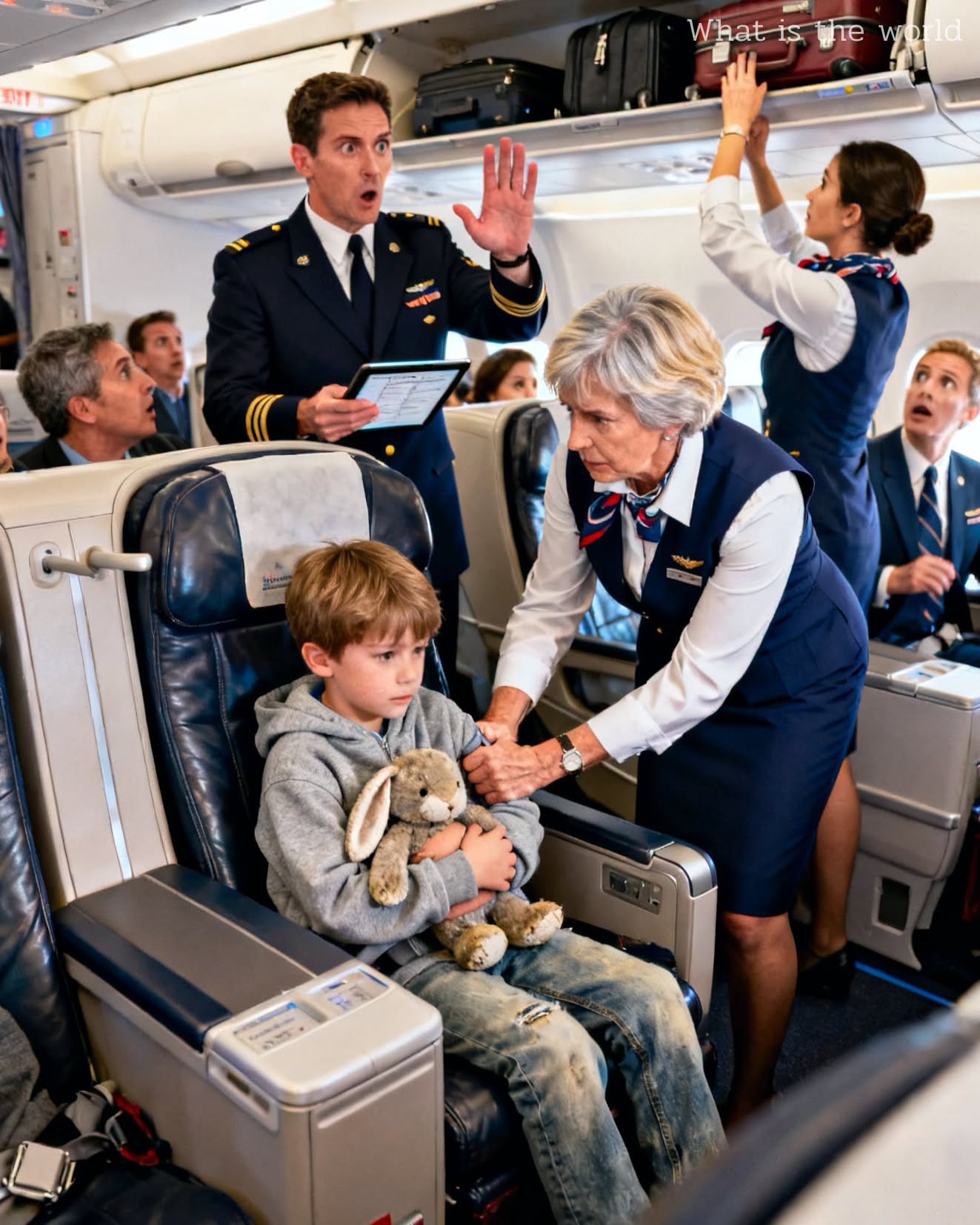
A quiet six-year-old boy sat by the window in first class, holding a worn stuffed rabbit and a tightly folded boarding pass. He wasn’t making noise, disturbing other passengers, or asking for anything special. He was simply waiting for his father, who had told him to remain in his seat.
But when a veteran flight attendant noticed the child sitting alone, she immediately assumed something was wrong.
What happened next turned an ordinary boarding process into an uncomfortable lesson about assumptions, patience, and the importance of treating every passenger with respect.
A Quiet Child on a Flight From Seattle to New York
The fictional story begins aboard Flight 271, preparing to depart Seattle for New York.
Ryan Carter, a flight attendant with nearly eight years of experience, was helping passengers settle into their seats. The cabin was filling with the usual sounds of boarding: luggage moving into overhead compartments, seat belts clicking, and passengers exchanging quiet conversations.
Then Ryan noticed a little boy sitting in seat 2A.
The child, Noah Parker, appeared to be about six years old. He wore a gray hoodie, faded jeans, and slightly worn sneakers. A small stuffed rabbit rested in his lap, its crooked ear showing signs of an old repair.
Noah looked nervous, but he wasn’t causing any trouble. He held his boarding pass carefully in both hands and kept glancing toward the aisle.
His ticket clearly displayed seat 2A.
Still, his presence in first class attracted the attention of Linda Mercer, a senior flight attendant who had worked for the airline for many years.
She stopped beside his seat and looked down at him.
“Sweetheart, I think you might be sitting in the wrong section,” she said.
Noah immediately looked at his boarding pass.
“My ticket says this is my seat,” he replied quietly.
The Flight Attendant Refused to Accept His Explanation
Linda folded her arms.
“First class is reserved for premium passengers,” she explained.
The little boy looked confused. He didn’t understand why an adult was questioning something his father had already arranged.
“But my dad bought it for me,” Noah said.
Several passengers nearby began paying attention. A businessman stopped looking at his phone, while a woman across the aisle lowered her magazine.
Noah tried to explain one more time.
“My dad told me to stay here and wait for him.”
Rather than checking the child’s ticket immediately, Linda insisted that he needed to move to another section of the aircraft.
Ryan watched the conversation become increasingly uncomfortable. He understood that seating mistakes could happen during boarding, but he also knew that the quickest way to resolve such a situation was to check the passenger record.
“Linda, I can verify his booking,” he offered.
She dismissed the suggestion, apparently convinced that the child had somehow ended up in the wrong seat.
Then she reached toward Noah’s arm, intending to escort him away from the row.
The boy instinctively pulled back toward the window, clutching his stuffed rabbit against his chest.
“Please,” he whispered. “My dad told me not to move.”
His voice trembled, and the passengers around him grew visibly uncomfortable.
Ryan stepped forward.
“Linda, please let go of him. We should check his reservation first.”
For a moment, the cabin fell quiet.
One Quick Check Changed Everything
Ryan asked Noah if he could look at his boarding pass.
After a brief hesitation, the child handed it over.
The ticket showed the flight number, the passenger’s name, and the assigned seat: 2A.
Instead of continuing the argument, Ryan walked to the cabin terminal and checked the passenger information.
He expected to find a simple booking mistake.
Instead, the record confirmed exactly what Noah had been saying.
The passenger was Noah Parker.
The flight was correct.
The seat assignment was confirmed.
There was no conflicting reservation indicating that another passenger was entitled to the seat.
Ryan looked at the screen again to make sure he had read everything correctly. Then he turned toward Linda.
“He’s assigned to 2A,” he said calmly. “His reservation is confirmed. He’s in the correct seat.”
Linda stared at him, momentarily speechless.
“But he’s alone,” she replied.
Ryan shook his head.
“That doesn’t change what his boarding pass says. We needed to verify the information before asking him to move.”
Across the aisle, another passenger quietly agreed.
“That’s what you should have done in the first place,” he said.
Nobody applauded or raised their voice. The facts were enough to make the situation uncomfortable.
The boy who had been treated as though he didn’t belong had been telling the truth from the beginning.
An Apology That Came Too Late to Prevent the Fear
Ryan returned Noah’s boarding pass.
The little boy carefully flattened the paper against his lap, smoothing out the creases with both hands. Then he placed it beside his stuffed rabbit.
Although the reservation had been confirmed, Noah didn’t immediately relax.
Just moments earlier, an adult in uniform had told him he was in the wrong place and had tried to move him. For a young child, discovering that he was right didn’t automatically erase the fear of what had happened.
A woman sitting across the aisle leaned slightly toward him.
“You’re okay, sweetheart. That’s your seat,” she reassured him.
Ryan crouched beside the row, leaving enough space so Noah wouldn’t feel surrounded.
“You can stay right here,” he told him. “Your seat is correct.”
Noah nodded, but he continued holding his rabbit close.
Linda stood silently for a moment before returning to the row.
“Your seat assignment is correct,” she told him.
The child looked up without answering.
After a pause, she added, “I shouldn’t have tried to move you before checking your reservation. I’m sorry.”
Noah rubbed the rabbit’s repaired ear between his fingers.
“Okay,” he said softly.
He didn’t demand anything. He didn’t argue or try to embarrass her in front of the other passengers. He simply returned his attention to the window, still waiting for his father.
His quiet response made the moment even more uncomfortable for the adults who had witnessed it.
The Lesson the Entire Cabin Could Understand
As boarding continued, the familiar sounds of the aircraft gradually returned. Passengers put away their belongings, adjusted their seat belts, and resumed their conversations.
But the atmosphere near the front of the cabin had changed.
The incident had begun with an assumption: a young child sitting alone in first class must somehow be in the wrong place.
That assumption had been made before anyone checked the most important piece of information.
His boarding pass.
Ryan couldn’t stop thinking about how easily the situation could have been avoided. A simple verification would have answered the question without frightening a child or turning an ordinary boarding process into a public confrontation.
Linda’s experience might have helped her recognize common seating problems, but experience alone couldn’t replace checking the facts.
The lesson was not that flight attendants should ignore possible mistakes. Their responsibilities include maintaining order, following safety procedures, and ensuring that passengers are seated appropriately.
The lesson was that concerns should be handled calmly, respectfully, and based on verified information.
A child’s age, clothing, appearance, or apparent financial circumstances should never be treated as proof that a valid ticket is somehow illegitimate.
And when a child says that a trusted adult has instructed them to remain in a particular place, the safest response is to establish the facts rather than create unnecessary fear.
A Small Question That Stayed With Ryan
Before returning to his duties, Ryan glanced toward seat 2A one more time.
Noah was sitting quietly beside the window. His stuffed rabbit rested in his lap, and his boarding pass was no longer crushed in his hands.
Everything around him appeared ordinary again.
Yet Ryan remembered one question the boy had asked after his seat was confirmed.
“Can I still wait here?”
It was a simple question, but it revealed how deeply the confrontation had unsettled him. Even after the evidence supported his explanation, he still needed reassurance that he wouldn’t be forced to leave.
Ryan had told him that he could stay.
And he hoped the child would remember that answer more clearly than the moment when someone had tried to make him feel unwelcome.
The incident offered a reminder that respect doesn’t depend on someone’s age, appearance, clothing, or seat assignment.
Sometimes, the most important thing an adult can do is pause, listen, and verify the facts before making a judgment.
Because the right question was never whether a six-year-old looked like he belonged in first class.
It was whether he had a valid seat assignment.
And he did.
The takeaway: Before judging someone based on appearances, take the time to understand the situation. A little patience can prevent unnecessary embarrassment, protect a child’s sense of security, and remind everyone that dignity should never depend on what others assume about them.