
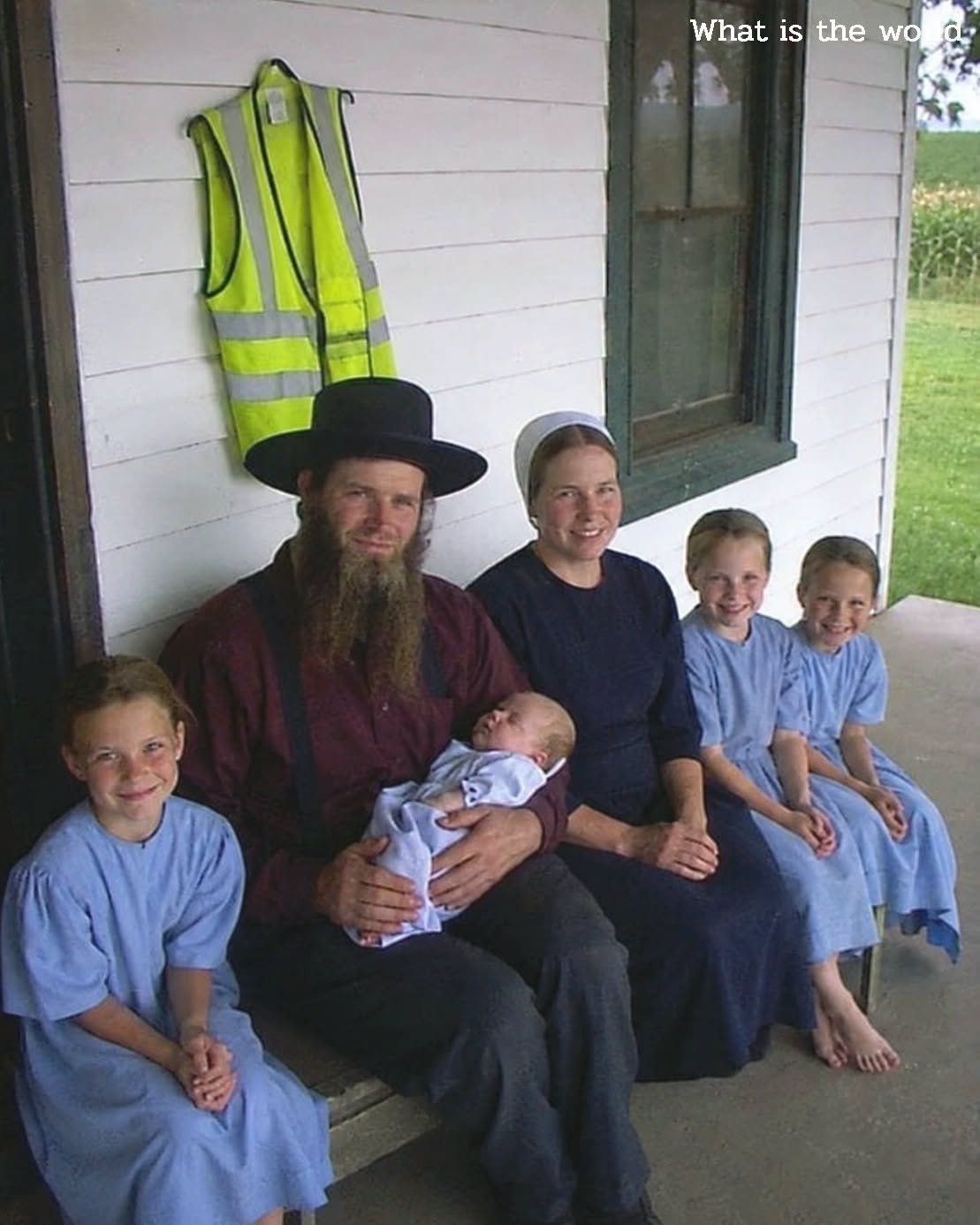
A forgotten family photograph, a sealed barn door, and a mystery that seemed impossible to solve. What could one tiny detail reveal about a disappearance that had haunted an entire community for decades?
A Photograph That Raised More Questions Than Answers
At first glance, it looked like an ordinary family photograph.
Six people stood in front of a red barn on a quiet autumn day. The father rested his hand on his teenage son’s shoulder, while the mother held their youngest child. Their other children stood close beside them, dressed simply and looking directly at the camera.
Nothing about the image suggested that it might one day become the center of a disturbing mystery.
But sometimes, the smallest details can change everything.
In this mysterious story, a photograph taken in 1991 would eventually raise questions about the disappearance of an Amish family from Holmes County, Ohio. For years, the family seemed to have vanished without explanation, leaving behind a farm, personal belongings, and a community struggling to understand what had happened.
Then, decades later, someone noticed something unusual in the background.
It was a detail that others had overlooked for years: a door in the barn wall that appeared to have disappeared.
The Morning an Entire Family Was Gone
The story begins on a warm July morning in 1992.
The surrounding farms were beginning their usual daily routines. Animals needed feeding, breakfast was being prepared, and families were getting ready for another day of work.
But one farm was unusually quiet.
According to the story, a neighbor became concerned when he noticed that the familiar sounds of the Miller family’s property had disappeared. The horses remained in their stalls, the chickens wandered around without being fed, and the farmhouse seemed strangely abandoned.
Inside, breakfast had been left on the table. Cups and dishes remained where the family had supposedly been sitting. Clothing still hung near the entrance, and the beds upstairs appeared undisturbed.
There was no obvious sign of a struggle.
There was also no explanation.
Jacob Miller, his wife Ruth, and their four children were nowhere to be found.
Had they decided to leave without telling anyone? Had something terrible happened to them? Or was there a hidden explanation that nobody had considered?
The uncertainty turned the family’s disappearance into a mystery that seemed to offer no clear answers.
Years of Searching and Endless Questions
As the hours passed, concern grew among neighbors and members of the local community.
Different explanations began to circulate. Some people wondered whether the family had left voluntarily. Others feared that they might have been victims of a crime or an accident.
Yet none of these possibilities appeared to explain every detail.
The family had seemingly left behind the possessions they would normally need to begin a new life elsewhere. Their farm and animals remained behind, and nobody could provide a convincing account of where they had gone.
Over time, the mystery became even more difficult to solve.
Without clear evidence or reliable leads, the search for answers appeared to have reached a dead end.
Years passed, and memories of the missing family slowly became part of local conversations about an unanswered mystery.
Then an old photograph resurfaced.
The Detail Hidden in Plain Sight
Many years after the disappearance, a man sorting through old belongings came across the photograph of the Miller family.
The picture brought back memories of the family and the unanswered questions surrounding their fate.
When it was shown to people who remembered the property, one observer noticed something unusual.
The barn door in the photograph did not seem to match the wall as people remembered it.
At first, the difference might have seemed insignificant. Old buildings change over time, and memories can become unreliable after many years.
But the more closely people examined the image, the more intriguing the detail became.
Could the photograph have captured something that had later been concealed?
The possibility was difficult to ignore.
A closer examination of the barn wall, according to the narrative, revealed markings that appeared consistent with a sealed entrance. What had once looked like an ordinary section of wood now seemed to suggest that something might have been hidden behind it.
The discovery changed the direction of the mystery.
Instead of asking only where the family had gone, people now had another question to consider:
What had been hidden inside the barn?
Behind the Sealed Door
Imagine discovering a door that appears to have been deliberately concealed for years.
The wood is weathered, the marks are difficult to distinguish, and the entrance blends into the surrounding wall. Without the photograph, the unusual feature might never have attracted attention.
In the story, opening the concealed entrance reveals a small, enclosed space.
Inside are old blankets, simple bedding, a wooden toy, and other objects suggesting that people may once have used the room as a hiding place.
These details introduce a troubling possibility: perhaps the family’s disappearance was not as sudden as it initially appeared.
Could they have been hiding from someone?
Had they been facing a problem that they felt unable to discuss with their neighbors?
Or was the room connected to an entirely different set of circumstances?
The objects alone cannot answer those questions. Their meaning depends on evidence that would need to be independently examined.
Nevertheless, the discovery creates a powerful mystery, transforming an ordinary photograph into a possible clue about a family’s hidden past.
The Possibility of Fear and Financial Pressure
One explanation explored in the original narrative involves financial difficulties and intimidation.
According to that account, the father had borrowed money to support his carpentry business. A disagreement over repayment allegedly developed into a frightening situation, leaving the family worried about losing their home and farm.
The story suggests that the pressure became so severe that the family began looking for a way to escape.
It is a disturbing possibility because financial problems can become much more dangerous when someone faces threats, isolation, or a lack of access to trustworthy advice.
However, the specific allegations and events described in this account have not been independently established here. They should not be treated as proven facts about identifiable people.
What the scenario illustrates is a broader human question: how far might a family go when fear begins to dominate everyday life?
For a family whose livelihood depends on its land, the possibility of losing a home can represent far more than a financial setback. It can threaten relationships, stability, identity, and the future of the children.
Under extreme pressure, even a decision that appears irrational to outsiders may seem like the only available option to those experiencing it.
The Cost of Living With a Secret
The most compelling part of this mystery is not simply the possibility of a hidden room.
It is the idea of a family trying to protect itself while carrying a secret that cannot easily be shared.
Imagine leaving behind familiar surroundings, relatives, friendships, and the only home your children have ever known.
Imagine rebuilding your life somewhere else while avoiding questions about your past.
Even if a person eventually finds safety, the emotional consequences of such a decision may last for years.
Children may grow up without understanding why their lives changed so dramatically. Parents may struggle with guilt over the relationships they left behind. A community may continue searching for answers long after the people involved have started a new life.
Silence can sometimes provide temporary protection, but it can also make it difficult to find support.
That is why stories involving disappearance, secrecy, and survival continue to capture people’s attention. They raise questions about fear, loyalty, trust, and the difficult decisions people make when they believe they have nowhere else to turn.
What Can One Photograph Really Tell Us?
Photographs preserve moments that people might otherwise forget.
A face, a building, a vehicle, or an object in the background can sometimes become important when viewed years later. Investigators routinely examine photographs and other historical records when searching for information about past events.
But a photograph also has limitations.
It can show what was visible at a particular moment, yet it cannot automatically explain why something happened or establish the identity of a person responsible.
A seemingly unusual detail may provide a useful lead, but it must be examined alongside other evidence before conclusions can be drawn.
That distinction is especially important when a story involves missing people, criminal allegations, or claims about real communities.
The most intriguing clue is not always the final answer. Sometimes, it is simply the beginning of a better question.
The Mystery Behind the Image
The image of a family standing beside a red barn offers a powerful starting point for a story about secrets and unanswered questions.
A door that appears in one photograph but not in a later view of a building invites curiosity. A quiet farmhouse and a missing family create a sense of uncertainty. The possibility of a hidden room introduces another layer of suspense.
Together, these elements encourage readers to look beyond the obvious and consider what might have remained unnoticed.
Yet the central lesson is not that every disappearance conceals a dramatic secret. It is that compelling stories require careful examination, and that real conclusions should be based on verifiable evidence rather than speculation.
Sometimes, an old photograph can help people rediscover an overlooked detail.
And sometimes, the most important thing it reveals is how much remains unknown.
If you discovered an unusual detail in a decades-old family photograph, would you investigate it—or assume it was nothing more than a coincidence?