
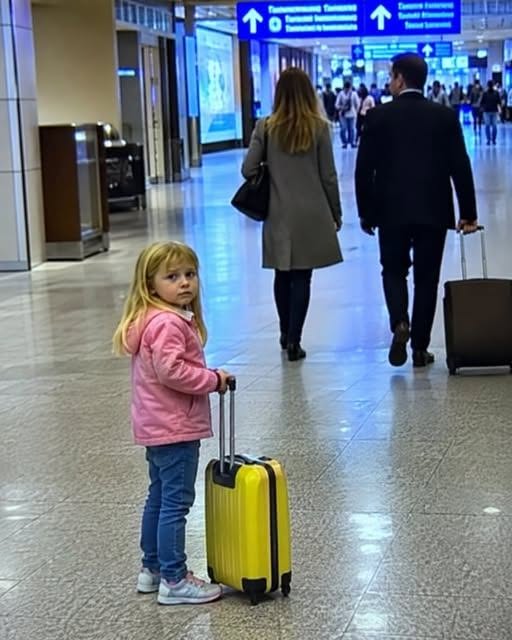
“Find your own way home.”
Those were the last words my mother said to me before she boarded a plane to Hawaii, leaving me alone at Denver International Airport.
I was only eight years old.
I stood frozen near Gate 14, clutching my purple backpack and staring at the phone in my hand. My mother, Annette, had just ended the call. I could still hear the laughter of her new husband, Calvin, and his children in the background.
They were going on vacation.
And I wasn’t invited.
“Stop being so pathetic and needy, Leah,” my mother had said. “You’re old enough to figure things out.”
Then she hung up.
I tried to hold back my tears, but they came anyway. Around me, families hurried toward their gates, children dragged their suitcases, and travelers hugged one another before boarding their flights.
Everyone seemed to belong somewhere.
Everyone except me.
I was an eight-year-old girl who had just been abandoned by the one person who was supposed to protect her.
And I had no idea that the phone number I had secretly memorized months earlier would change my life forever.
The Stranger Who Asked If I Was Lost
“Honey, are you okay? Is your mom in the restroom?”
I looked up at a man wearing an airport uniform. He had a kind face, but I could tell he was trying to understand why a little girl was sitting alone with tears running down her cheeks.
“She… she left,” I whispered.
“Don’t worry. We’ll find her.”
He reached for his radio.
“I’m not lost,” I said quietly.
He paused.
“I was left.”
For a moment, he didn’t say anything.
Then he crouched beside me and gently asked me to explain what had happened.
I pointed toward the gate.
“My mom is on that plane. She’s going to Hawaii. She told me to find my own way home.”
His expression changed immediately.
He called for assistance, and within minutes, I was taken to a small office where airport staff could keep me safe while they figured out what to do.
A woman with a name badge knelt in front of me.
“Sweetheart, is there another family member we can call? Maybe your grandmother, an aunt, or your father?”
At the mention of my father, I hesitated.
My mother had spent years telling me he didn’t care about me.
“He chose his business over you,” she always said. “He’s gone, Leah. It’s just us now.”
I had believed her because I was a child, and children tend to believe the people they depend on.
But there was something my mother didn’t know.
I had memorized my father’s phone number from an old address book months earlier. His name was written beside it in tiny, faded handwriting.
Gordon Calvinson.
I wasn’t supposed to ask about him. Whenever I did, my mother became angry, and Calvin would laugh as if the whole subject were a joke.
Still, I remembered the number.
I had repeated it to myself so many times that I could recall every digit.
“I have another number,” I whispered.
“My daddy’s.”
The woman looked surprised, but she picked up the phone and dialed.
One ring.
Two rings.
Three.
Then a deep male voice answered.
“Gordon Calvinson speaking.”
The woman began explaining that she was calling from the airport, but I couldn’t wait any longer.
“Daddy?”
The word came out so softly that I almost didn’t recognize my own voice.
Silence.
Then I heard him take a sharp breath.
“Leah? Is that you?”
And for the first time in years, someone on the other end of the phone sounded as if my existence mattered.
“Yes,” I sobbed.
“Mom left me at the airport. She went to Hawaii, and she told me to find my own way home. I don’t know what to do.”
My father didn’t yell. He didn’t ask why I had called him or tell me I was being difficult.
His voice became calm and firm.
“Leah, listen to me carefully. You are safe. I’m coming to get you. I need you to stay with the woman helping you, okay? I’m on my way.”
He asked to speak with the airport employee.
I couldn’t hear everything they discussed, but I heard the woman’s voice become more serious as she listened.
When she hung up, she looked at me with an expression I couldn’t understand.
“Your father is coming, sweetheart. He’ll be here soon.”
For the first time that day, I allowed myself to hope.
My Father Arrived in Less Than an Hour
Fifty-three minutes later, a man in a dark suit rushed into the airport office.
He was taller than I remembered from the old photograph my mother kept hidden in a box. His tie was loose, his hair was messy, and his eyes were red.
He barely glanced at the people standing around him.
His eyes searched the room until they found mine.
Then he dropped to his knees and opened his arms.
I ran to him.
I buried my face in his jacket, holding on as tightly as I could. He wrapped both arms around me, and I felt his body trembling.
“I’m so sorry, baby girl,” he whispered into my hair. “I’m so, so sorry.”
I didn’t understand why he was apologizing.
I only knew that I had spent years believing he didn’t want me, and now he was holding me as if he had been afraid of losing me forever.
“I’ve got you,” he said. “You’re safe. I’m here.”
He didn’t let go of my hand as we left the airport office.
Later, aboard his private plane, a flight attendant brought me a cup of hot chocolate topped with whipped cream. My father sat beside me, still holding my hand.
For a while, neither of us spoke.
Then he began telling me the truth about what had happened after the divorce.
According to him, my mother had moved without informing him, changed her phone number, and made it increasingly difficult for him to contact me. When he finally tried to reconnect with me, he said, she had accused him of attempting to take me away unlawfully.
He told me that legal restrictions had prevented him from approaching me while the dispute was being handled.
“Your mother told me you didn’t want to see me,” he said, his voice breaking. “She told me you were happy without me.”
I stared at him.
“She told me you didn’t care.”
His face crumpled.
“Leah, I never stopped caring. Not for one single day.”
I wanted to believe him, but I was eight years old, and my whole understanding of my family had just been turned upside down.
So he showed me something.
He opened his phone and began showing me photographs of a bedroom.
It had soft blue walls, a bookshelf, a desk, toys, and a bed covered with a beautiful quilt.
“That’s your room,” he explained.
I looked at him in confusion.
“My room?”
“I updated it every year,” he said. “For your birthdays. I kept hoping that one day you’d come home.”
In one photograph, a large teddy bear sat in the middle of the bed. A red ribbon was tied around its neck, and a small tag carried my name.
Leah.
I touched the screen with my finger.
My father had prepared a place for me, even when he believed he might never get the chance to bring me home.
That was the first moment I began to understand that perhaps the story I had been told about him wasn’t the whole truth.
The First Night I Felt Safe in Years
My father’s home in Seattle was nothing like the house I had left behind.
There were no sarcastic comments at dinner, no one making fun of me for dropping a fork, and no one telling me I was too sensitive.
That evening, my father made pancakes for dinner.
He placed a plate in front of me, added chocolate chips, and smiled.
“Is… is that allowed?” I asked.
He looked genuinely confused.
“Of course it is. You’re allowed to enjoy your dinner, Leah.”
Then he asked me a question that seemed almost impossible.
“What do you like to eat?”
I stared at him.
No one had asked me that in a long time.
I had grown so accustomed to making myself small that even a simple question about my preferences made me feel as though I might cry.
After dinner, we watched old black-and-white movies together. My father eventually fell asleep in an armchair, exhausted from the journey.
I curled up on the couch with my purple backpack beside me.
For the first time in three years, I slept through the night without a nightmare.
But the next morning, my father explained that there were things we still needed to deal with.
What had happened at the airport could not simply be forgotten.
He wanted to make sure I was protected, and he wanted the truth about my mother’s actions to be investigated.
I didn’t know what that meant for the future.
I only knew that I wasn’t going back to the life I had left behind without someone making sure I would be safe.
The Recording That Changed Everything
Over the following week, I met my father’s legal team.
They asked careful questions about my life with my mother and her new husband, Calvin. They wanted to understand what had happened before the trip, what I had heard during the phone call, and whether there was anything that could help establish the facts.
Then I remembered something.
I had recorded the phone conversation at the airport.
I couldn’t explain exactly why I had done it. Perhaps some part of me had been frightened enough to preserve what was happening, even if I didn’t understand its importance.
My father asked whether I was comfortable letting the lawyers hear it.
I nodded.
When the recording began, the room became silent.
My mother’s voice came through the speaker.
“Calvin thinks it would be better if we had some time with our new family…”
Then Calvin’s voice followed, dismissive and cruel.
“Some kids need to learn independence the hard way.”
There was laughter.
Then my mother’s voice again.
“Stop being so pathetic and needy, Leah. Find your own way home.”
The recording ended.
Nobody spoke for several seconds.
One of the lawyers closed her eyes and took a slow breath.
My father sat very still.
“What happened to my daughter was unacceptable,” he said finally. “We need to establish exactly what happened and make sure she’s protected.”
The lawyers began organizing the evidence, documenting the timeline, and determining what action could be taken.
They also examined the financial arrangements connected to my care.
That investigation raised another troubling question.
My father said he had been sending money each month to support me. But my school lunch account had frequently been short of funds, and I had often depended on the free meals provided at school.
The lawyers began tracing the payments and reviewing the available records.
If the money had been used improperly, there would need to be accountability.
For the first time, I realized that what had happened to me might be more complicated than a cruel vacation decision.
There were questions about my safety, my father’s efforts to reach me, and whether the adults responsible for caring for me had fulfilled their obligations.
And now, there was evidence that could help uncover the truth.
When My Mother Finally Called
My mother returned from Hawaii expecting to find everything exactly as she had left it.
Instead, she discovered that I was gone.
My father had arranged for my belongings to be moved under the appropriate legal arrangements, and the situation was now being handled through the authorities and his legal representatives.
She called him that evening.
I was sitting in his study when the phone rang. He looked at me before answering.
“Are you comfortable hearing her voice?” he asked.
I was scared, but I nodded.
He put the call on speakerphone.
“Gordon, what on earth do you think you’re doing?” my mother shouted. “Where is my daughter?”
My father’s voice remained calm.
“Leah is safe. You left her alone at Denver International Airport. The circumstances have been reported, and the recording is being reviewed.”
There was a long silence.
“That isn’t what happened,” my mother replied. “She was supposed to wait for someone.”
“Who was she supposed to wait for, Annette?”
She hesitated.
Then her voice changed. The anger gave way to a softer, pleading tone.
“I want my daughter back. She’s my child.”
I had heard that tone before. It was the voice she used when she wanted me to forget something hurtful she had said.
This time, I reached for the phone.
“Mom?”
Her voice brightened immediately.
“Leah! Baby! Thank goodness. Come home. This is all a misunderstanding.”
I looked at my father.
He didn’t tell me what to say. He simply sat beside me, allowing me to speak for myself.
“No,” I said.
There was silence on the other end.
“Sweetheart, listen to me. Your father is confusing you—”
“You left me,” I interrupted.
My voice was shaking, but I kept going.
“You left me alone at the airport because Calvin didn’t want me there. You told me I was pathetic. You told me to find my own way home.”
“I didn’t mean it, Leah!”
“Yes, you did.”
For once, I didn’t apologize for telling the truth.
I handed the phone back to my father.
My mother continued arguing, pleading, and insisting that everything could be fixed. But I turned toward the window and watched the lights of Seattle shining in the distance.
I had spent years trying to understand why she treated me as if I were a burden.
I was finally beginning to understand that her choices were not a measure of my worth.
I was eight years old.
I deserved to be protected.
I deserved to be loved.
And I had done nothing to deserve what happened to me.
The Truth About Calvin
My father’s legal team continued investigating the circumstances surrounding my abandonment.
A private investigator began looking into Calvin’s past and speaking with people who had known him.
One of those people was a woman named Claudia.
She told the investigators that she had once been in a relationship with Calvin and had two sons. According to her account, he had pressured her to prioritize their relationship over her children.
She described how he had made her feel that being a parent was an obstacle to being loved by him.
“He makes you feel as if your children are an inconvenience,” she explained. “Then he isolates you, and eventually he tries to replace the people who were there before him.”
Her account raised further questions about Calvin’s behavior and whether there were similarities between the experiences of different families.
The investigators also examined financial records related to the child support payments my father said he had made.
Those records needed to be reviewed carefully, but they could potentially help establish whether the money intended for my care had been used for other purposes.
As the investigation continued, my father’s team began building a detailed timeline of the events leading up to the airport incident.
Every document mattered.
Every conversation mattered.
And every piece of evidence helped establish what had actually happened.
I didn’t understand all the legal details. I was still a little girl trying to adjust to a completely different life.
But I understood one thing.
For years, I had been told that nobody would believe me.
Now, people were listening.
The Day I Stopped Feeling Invisible
A few weeks later, I began speaking with a therapist named Dr. Amanda Chen.
Her office had a large painting of koi fish on the wall. She wore soft cardigans and spoke gently, never rushing me when I struggled to find the right words.
During one session, she asked me a question.
“How did it feel when your mother said those things to you?”
I looked down at my hands.
“I felt… erased.”
She waited patiently.
“And how do you feel now?”
I thought about the airport. The phone call. My father’s arms wrapped around me. The bedroom he had kept ready for me. The pancakes we had eaten together on my first night.
I thought about how frightened I had been when I realized my mother was actually leaving without me.
Then I took a breath.
“Like I exist,” I whispered.
Dr. Chen smiled gently.
“You have always existed, Leah. And you have always mattered.”
For a moment, I couldn’t speak.
I had spent so much of my childhood believing that I was the problem. I thought I was too sensitive, too needy, too difficult to love.
But I was beginning to understand something that every child deserves to know.
Adults are responsible for their choices.
A child is not responsible for making a parent behave with kindness.
I hadn’t caused my mother to abandon me. I hadn’t caused the arguments between my parents. And I hadn’t deserved to be treated as an inconvenience.
I was simply a little girl who needed her family.
And needing love was never something to be ashamed of.
A New Beginning With My Father
The legal proceedings continued as the authorities reviewed the evidence and the family court considered the circumstances surrounding my care.
My father sought custody and appropriate legal protections to keep me safe. The court process would determine the arrangements based on the evidence and the applicable law.
For the first time, I had an adult who was willing to stand beside me through all of it.
My father never promised that everything would be easy.
He promised that I wouldn’t have to face it alone.
He helped me settle into my new school, listened when I talked about my nightmares, and learned which foods I liked and which movies made me laugh.
Sometimes, he still looked at me with an expression of sadness.
I eventually asked him why.
“Because I missed so much,” he admitted. “Your birthdays. Your first days of school. All those little moments I can never get back.”
I took his hand.
“We can have new moments,” I told him.
He smiled, although his eyes filled with tears.
That was when I realized that healing didn’t mean pretending the past hadn’t happened.
It meant allowing the future to become something different.
I still remembered the airport. I still remembered my mother’s words and the feeling of watching her plane leave without me.
Those memories didn’t disappear overnight.
But they no longer defined everything about my life.
I had a home where I could ask questions without being mocked. I had someone who listened when I spoke. And I had begun to understand that I was worthy of love even when someone failed to give it to me.
My father had not been able to protect me from everything that happened before that day.
But he was there now.
And together, we were building something neither of us wanted to lose again.
I used to believe my mother had the final say over who I was and where I belonged.
I was wrong.
The little girl left alone at Gate 14 was not pathetic. She was not a burden. She was not unwanted.
She was a child who had been hurt by the people she trusted.
And she deserved a chance to begin again.
Sometimes, the moment that breaks your heart is also the moment that changes your life.
For me, it began with a phone call.
One whispered word.
“Daddy?”
And the voice that answered changed everything.