
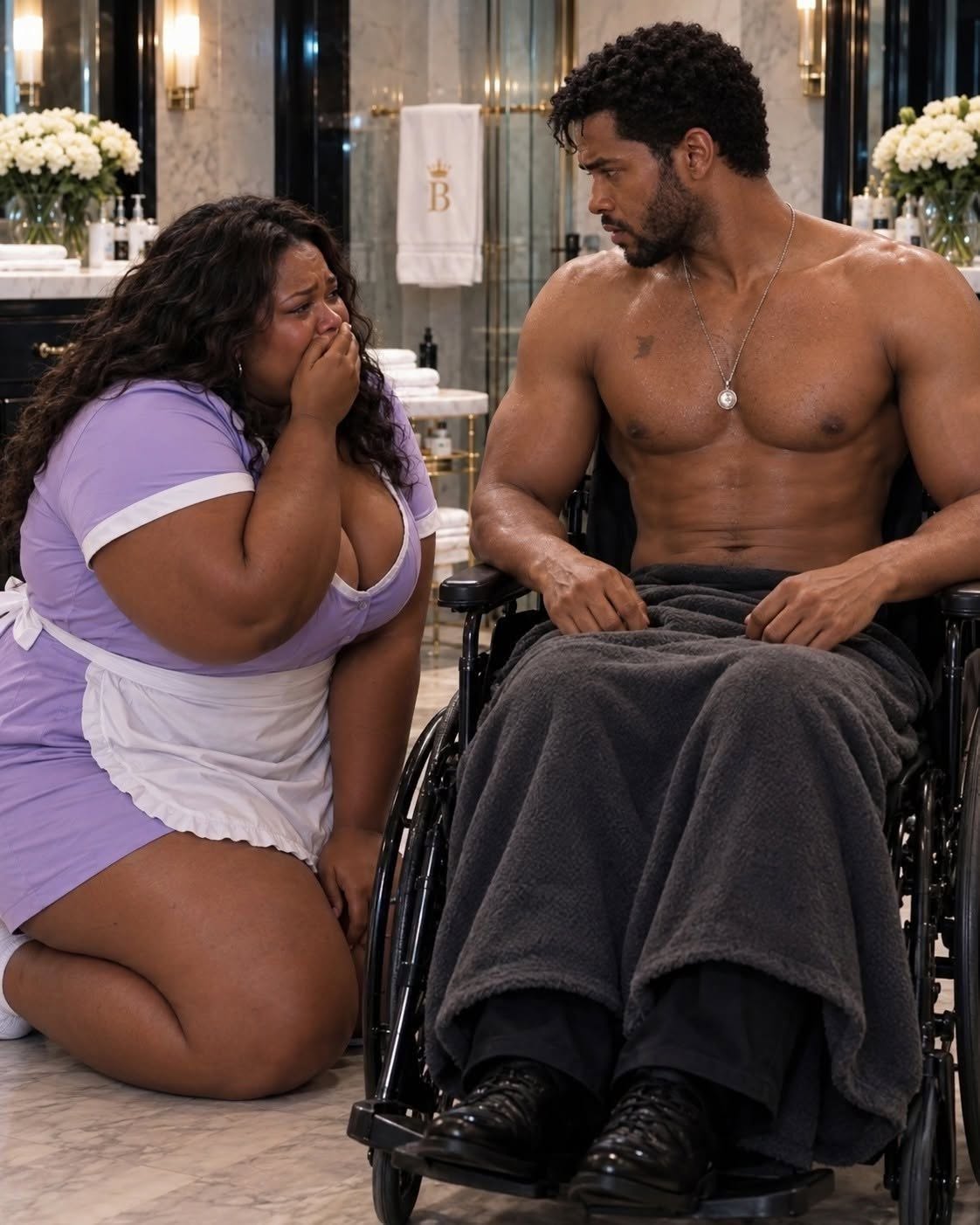
I took the job because my children were hungry.
There was nothing noble about it. No grand plan. No belief that I was about to change my life.
I simply needed money.
My son Brandon was sick, my daughter Emma had started asking whether we would have enough food for dinner, and I had almost nothing left in my bank account. Pride had become a luxury I could no longer afford.
So when someone offered me a job caring for a wealthy, paralyzed billionaire, I accepted.
I had no idea that the decision would uncover a seventeen-year-old secret.
And I certainly had no idea that the man in the wheelchair was connected to the brother I had spent seventeen years believing was dead.
The Billionaire in the Wheelchair
The man in the wheelchair turned toward me slowly.
For a moment, neither of us spoke.
He was younger than I expected.
Forty, perhaps forty-one.
Dark hair fell across his forehead. His face was pale from spending months indoors, but there was something powerful about him. Not physical strength anymore, but presence.
The kind of presence that could make an entire room feel smaller.
His gray eyes settled on me.
Cold.
Observant.
“You’re the new caregiver?” he asked.
“Yes.”
“What’s your name?”
“Rachel Morgan.”
Something changed in his expression.
It lasted less than a second.
A slight tightening around his eyes.
A flicker of recognition.
Then it disappeared.
“Rachel Morgan,” he repeated quietly.
“Yes.”
He turned his wheelchair toward the window.
“You won’t last.”
Maybe a year earlier, I would have walked out.
Maybe I would have told him that nobody deserved to be spoken to like that.
But hunger changes you.
When your child is sick in a freezing apartment, dignity becomes something you promise yourself you will recover later.
“I only need to last long enough to get paid,” I told him.
His chair stopped.
The corner of his mouth moved.
It wasn’t quite a smile.
“Honest.”
“I don’t have the energy to lie.”
That made him look at me again.
Before he could respond, the housekeeper entered.
Her name was Mrs. Alvarez. She was in her sixties, with silver hair, gentle eyes, and the kind of posture that suggested she wasn’t intimidated by anyone.
“Mr. Bennett’s evening routine begins at five,” she explained. “Medication, bathing, dinner, stretching exercises, and then bed preparation.”
I nodded.
“And if I do something wrong?”
“Ask.”
Christopher gave a humorless laugh.
“She means ask her. Not me.”
Mrs. Alvarez ignored him.
“He has limited movement below the chest. Some sensation has returned in his arms and hands, but he fatigues quickly. Never move him without telling him first.”
“I understand.”
She looked at me seriously.
“And Rachel?”
“Yes?”
“Do not treat him like glass.”
Christopher stared toward the window.
“I’m still here, Maria.”
“I know,” she replied calmly. “That’s why I’m saying it in front of you.”
For the first time that day, I almost smiled.
The Necklace
The bathroom attached to Christopher’s bedroom had been completely modified.
There were handrails, a mechanical lift, a wide shower, and a padded bathing chair.
The equipment probably cost more than the apartment where my children and I lived.
When Mrs. Alvarez finally left us alone, silence filled the room.
Christopher watched as I organized the towels.
“You’ve never done this before.”
“No.”
“You’re nervous.”
“Yes.”
“Good.”
I looked at him.
“Why is that good?”
“People who aren’t nervous usually hurt me.”
I swallowed.
That answer told me more about him than he probably intended.
I approached carefully.
“I need to help you remove your shirt.”
“I’m aware.”
I started with the top button.
My fingers trembled.
Not because of him.
Because somewhere across Chicago, Brandon was still sick.
Because I had twelve dollars left in my purse.
Because if I lost this job, I had no idea what would happen next.
I opened the first button.
Then the second.
An old scar crossed Christopher’s shoulder.
When I opened the third button, I noticed a thin silver chain around his neck.
At first, I barely paid attention.
Then the pendant slipped free.
A small oval locket.
Silver.
Scratched along one edge.
Two initials were engraved across the front.
R.M.
Everything inside me stopped.
The towel fell from my hand.
Christopher looked down.
Then back at me.
“What?”
I stared at the locket.
There was no mistake.
I knew the tiny dent near the clasp.
I knew the uneven engraving.
I knew the crooked star scratched into the back by a child using the tip of a sewing needle.
I had held that locket in my hands when I was nineteen.
It had belonged to my older brother.
Ryan Morgan.
The brother I had buried seventeen years earlier.
Or at least, I thought I had.
“Where did you get that?” I whispered.
Christopher’s expression became completely still.
“Get what?”
“The locket.”
His hand immediately moved toward the pendant.
“That belonged to my brother.”
“You’re mistaken.”
“No.”
My voice broke.
“No, I’m not.”
He closed his shirt.
“Leave.”
“What?”
“I said leave.”
“Tell me where you got it.”
“Your shift is over.”
“You don’t understand.”
“I understand perfectly.”
His voice became sharp.
“Get out of this room.”
My desperation finally exploded.
“My brother died seventeen years ago!”
The words echoed through the bathroom.
Christopher froze.
I pressed one hand against the counter.
“His name was Ryan Morgan. He was twenty-four. He disappeared after telling me he’d gotten involved with people he shouldn’t have trusted.”
Christopher’s face lost its color.
“He wore that locket every day,” I continued. “It was a gift from our mother before she died.”
Silence.
“So don’t tell me I’m mistaken.”
He closed his eyes.
I stepped closer.
“Who are you?”
His eyes opened.
“You already know my name.”
“Christopher Bennett.”
“That’s right.”
“No.”
I pointed toward the necklace.
“I know who Christopher Bennett is. Everyone in Chicago does. Billionaire real-estate investor. Hotels. Construction. Finance. But Ryan had that locket long before Christopher Bennett’s name ever appeared in a newspaper.”
His fingers tightened around the pendant.
“Leave, Rachel.”
“What happened to my brother?”
His wheelchair suddenly moved backward.
“Get out!”
The shout brought Mrs. Alvarez running.
She stopped in the doorway.
“Christopher?”
He pointed toward me.
“Take her home.”
Mrs. Alvarez looked between us.
“What happened?”
“Now.”
I didn’t move.
“Rachel,” she said softly.
“Ask him about the necklace.”
Her expression changed.
That was all I needed to see.
She knew.
My stomach dropped.
“You know too.”
Mrs. Alvarez looked away.
“Oh my God.”
I backed toward the doorway.
“You both know.”
“Rachel…”
“If you knew my brother—if you knew anything about what happened to him—”
“Enough!” Christopher shouted.
I stared at him through tears.
Then I picked up my coat.
“I need this job,” I said quietly. “More than you could possibly understand.”
His eyes met mine.
“But if that necklace came from my brother, I will find out how.”
Then I walked out.
Five Thousand Dollars
Mrs. Alvarez followed me downstairs.
“Rachel.”
I kept walking.
“Please.”
I stopped near the front door.
She lowered her voice.
“You should go home tonight.”
“Was Ryan here?”
She hesitated.
That hesitation answered everything.
“When?”
“I cannot tell you.”
“Cannot or will not?”
“Both.”
I laughed bitterly.
“My son is sick. My daughter is hungry. I came here because I had nothing left. And now I find the one object that belonged to my dead brother hanging around your employer’s neck.”
Mrs. Alvarez looked genuinely shaken.
“I am sorry.”
“That doesn’t help.”
“No.”
She reached into her pocket and handed me an envelope.
“Take this.”
I stared at it.
“What is it?”
“Your first week’s salary.”
“I worked two hours.”
“Mr. Bennett pays caregivers weekly in advance.”
“How much?”
“Five thousand dollars.”
I thought I had misheard her.
“Five thousand?”
“Yes.”
My hands trembled.
That was more money than I had earned in three months at my old cleaning job.
“Why?”
She looked toward the staircase.
“Because no one stays.”
I thought of Brandon.
Medicine.
Food.
Heat.
Rent.
I closed my fingers around the envelope.
“Am I fired?”
“I don’t know.”
A Sick Child and a Second Chance
I went straight home.
The first thing I did was take Brandon to an urgent care clinic.
He had pneumonia.
Thankfully, it wasn’t severe enough to require hospitalization, but the doctor warned me that he needed warmth, rest, fluids, medicine, and proper food.
I paid the bill without checking the price.
That alone nearly made me cry.
Then I bought groceries.
Real groceries.
Chicken.
Milk.
Fruit.
Bread.
Eggs.
Cereal Emma loved.
Cookies.
Fresh vegetables.
Medicine.
Two new blankets.
A space heater.
Emma stared at the bags as though I had brought home Christmas.
“Mommy, are we rich?”
I laughed and cried at the same time.
“No, baby.”
I kissed her forehead.
“We just got lucky.”
That night, after both children were asleep, I sat at our tiny kitchen table.
Then I pulled an old cardboard box from the closet.
Ryan’s box.
I had carried it through six apartments and two marriages.
Inside were photographs, letters, school papers, a baseball glove, and one picture that made my heart stop.
Ryan at twenty-one.
Standing beside me outside our grandmother’s house.
Around his neck was the same silver locket.
I turned the photograph over.
Summer 2007.
Three years before his supposed death.
My hands began to shake.
Ryan had disappeared in October 2010.
The police had found his car near Lake Michigan.
Eleven days later, a badly decomposed body had washed ashore.
The police said identification had been made through dental records and personal effects.
There had been no viewing.
We cremated what we were told was Ryan’s body.
I had stood beside a cemetery holding a small urn while a priest talked about eternal peace.
But what if it hadn’t been Ryan?
The thought was impossible.
Insane.
And yet the necklace existed.
I barely slept.
At seven the next morning, my phone rang.
Unknown number.
“Rachel?”
I knew the voice immediately.
Christopher Bennett.
I sat up.
“What do you want?”
A long silence followed.
“Come back.”
“Why?”
“Because you need the job.”
Anger flared inside me.
“And you need someone willing to tolerate you.”
Another pause.
“That too.”
I looked toward Brandon, sleeping on the couch.
“Will you tell me about Ryan?”
“No.”
I almost hung up.
Then Christopher spoke again.
“Not yet.”
I gripped the phone.
“What does that mean?”
“It means there are things you don’t understand.”
“Then help me understand.”
“I can’t.”
“You mean you won’t.”
“Yes.”
Five thousand dollars a week could change my children’s lives.
It could pay our medical bills.
Put food in the refrigerator.
Move us out of that terrible apartment.
Give Emma new shoes.
Give Brandon everything he needed to recover.
And perhaps, if I stayed close to Christopher, I might finally discover what happened to my brother.
“What time?”
“Four.”
I went back.
The Man Beneath the Billionaire
Christopher behaved as though nothing had happened.
For three days, we barely spoke except when necessary.
I helped him bathe.
Dress.
Eat.
Transfer to bed.
Stretch his arms.
Manage his medication.
And every day, the silver locket remained around his neck.
He never removed it.
I also began noticing things.
Christopher hated mirrors.
He refused visitors after dark.
He woke from nightmares shouting names.
Daniel.
Marcus.
Ryan.
The first time I heard my brother’s name, I nearly dropped a glass.
Christopher pretended he hadn’t said it.
By the end of the first week, Brandon’s fever was gone.
Emma had stopped asking whether we had enough food.
I paid three months of overdue rent.
Then something unexpected happened.
Christopher asked about my children.
“What are their names?”
“Brandon and Emma.”
“How old?”
“Eight and five.”
“Father?”
I stiffened.
“Gone.”
“Dead?”
“No.”
He glanced at me.
“He left when Emma was two.”
“Why?”
“Because responsibility bored him.”
Christopher looked almost offended.
“His loss.”
“Yes.”
For a few seconds, neither of us spoke.
Then he asked:
“Brandon likes baseball?”
I stared at him.
“How do you know that?”
“You mentioned buying him a glove yesterday.”
I relaxed slightly.
“Yeah. He loves the Cubs.”
Christopher smiled.
“Poor kid.”
I laughed before I could stop myself.
It surprised both of us.
That was the first crack in the wall between us.
Days became weeks.
I still didn’t trust him.
But I began to see the person beneath the billionaire.
Christopher had been injured in a car crash fourteen months earlier.
His spinal cord had been damaged.
Doctors told him walking again was unlikely.
Before the accident, he had controlled a business empire worth billions.
Afterward, people around him began speaking softly, making decisions for him, and treating him like a tragedy.
No wonder he was angry.
One evening, while helping him stretch his left hand, I asked:
“Why did you fire the other caregivers?”
“One stole medication.”
I paused.
“Another took pictures of me while I slept.”
“And the third?”
“She cried every time she bathed me.”
I winced.
“I would have fired her too.”
He looked surprised.
“Really?”
“Being paralyzed doesn’t mean you want someone mourning over your shampoo.”
Christopher laughed.
A real laugh.
It transformed his face.
For a moment, he looked much younger.
Then the locket shifted against his chest.
And the mystery returned.
The File
Two days later, everything changed.
Mrs. Alvarez was downstairs when I entered Christopher’s study carrying coffee.
He was on the phone.
“No,” he said sharply. “Rachel doesn’t know.”
I froze.
A man’s voice answered through the speaker.
I couldn’t make out everything.
Then I heard one sentence clearly.
“If she finds the file, she’ll know what happened to Ryan.”
My blood turned cold.
Christopher saw me.
His face changed.
He ended the call.
“What file?”
“Rachel…”
“What file?”
He looked toward the door.
“Close it.”
I put the coffee down.
“No.”
“Close the door.”
“Tell me.”
His jaw tightened.
“Please.”
That word stopped me.
Christopher Bennett did not say please.
I closed the door.
He turned toward the desk.
“Bottom drawer.”
“What?”
“Open it.”
I moved around the desk.
The drawer was locked.
Christopher gave me the key.
Inside was a black folder.
My hands shook as I opened it.
The first page contained a photograph.
Ryan.
Alive.
Older.
The photograph had been taken in 2013.
Three years after his supposed death.
I couldn’t breathe.
I touched his face in the photograph.
Ryan stood beside Christopher outside a building in New York.
He looked thinner.
Harder.
But unmistakably alive.
Tears blurred everything.
“You knew.”
Christopher said nothing.
“You knew he was alive.”
“Yes.”
I slapped him.
The sound echoed through the room.
Mrs. Alvarez appeared in the doorway.
Christopher raised one hand.
“Leave us.”
She hesitated.
Then obeyed.
I stared at him.
“You let me bury an empty urn.”
“I was twenty-three.”
“You let my grandmother die believing he was dead!”
“I didn’t know you existed.”
“You knew his name.”
“Ryan wasn’t using his real name.”
I threw the folder onto the desk.
“Then explain.”
Christopher looked exhausted.
“My father wasn’t a good man.”
I said nothing.
“Everyone remembers Arthur Bennett as a visionary. A developer. A philanthropist. He built hospitals and schools.”
His voice hardened.
“He also laundered money for organized crime.”
I stared at him.
“Ryan discovered it.”
The Truth About Ryan
Ryan had worked for one of the Bennett construction companies.
He was an electrician.
According to Christopher, Ryan noticed invoices for materials that never arrived, properties purchased through shell companies, and payments routed through offshore accounts.
He tried reporting what he had found internally.
Arthur Bennett discovered him.
“Ryan was offered a choice,” Christopher said.
“Disappear or die.”
“So he disappeared.”
“Yes.”
“And the body?”
“Someone else.”
I covered my mouth.
“Who?”
“I don’t know.”
“You expect me to believe that?”
“I was a kid trapped inside my father’s world.”
“You were twenty-three.”
“Yes.”
His voice dropped.
“And terrified.”
I looked again at the photograph.
“What happened after this?”
“Ryan worked with federal investigators.”
My heart pounded.
“He was a witness?”
“Yes.”
“Where is he?”
Christopher said nothing.
“Where is my brother?”
“I don’t know.”
I leaned closer.
“You’re lying.”
“I wish I were.”
He took a breath.
“In 2014, Ryan vanished from witness protection.”
My knees weakened.
“What?”
“No one knew whether he ran or was taken.”
“And the locket?”
Christopher touched it.
“He gave it to me.”
“Why?”
“Because I helped him escape my father.”
The room became silent.
I stared at the man I had been caring for.
“You saved him?”
“He saved me first.”
Christopher looked down.
“In 2010, my father discovered I had copied financial records. He planned to send me away.”
“Where?”
“Somewhere I wouldn’t come back from.”
Ryan found out.
“He put me in a truck and drove me across three states. He risked his life for me.”
I looked at the locket.
“Why give you that?”
“Ryan said if anything happened to him, I should find Rachel Morgan.”
My breath stopped.
“He told you about me?”
“He told me you were his little sister.”
I began crying.
“Then why didn’t you find me?”
“My father found me first.”
Christopher’s voice cracked.
“He threatened everyone I cared about. Ryan disappeared. I was forced back into the company.”
“You became part of it.”
“Yes.”
“You became a billionaire.”
“Yes.”
“Using dirty money.”
“At first.”
He didn’t defend himself.
“I spent years separating the legitimate companies from my father’s criminal operations. After he died, I turned evidence over to prosecutors.”
“Why wasn’t this public?”
“Deals. Immunity agreements. Sealed investigations.”
I shook my head.
“And your accident?”
Christopher went still.
“It was a car crash.”
“Was it an accident?”
Silence.
That silence told me enough.
“Who did it?”
“I don’t know.”
“You’re lying again.”
His hand tightened around the wheelchair.
“I know who I suspect.”
“Who?”
He looked directly at me.
“My uncle. Marcus Bennett.”
The name immediately connected with the nightmares I’d heard him shouting.
“Why?”
“Because Marcus took control of certain company assets after my accident.”
“Assets connected to your father?”
“Yes.”
“And Ryan?”
Christopher hesitated.
“I think Marcus knows where he is.”
My heart slammed against my ribs.
“You think Ryan is alive?”
“I don’t know.”
“That isn’t what I asked.”
Christopher held my gaze.
“I think there’s a chance.”
Seventeen years of grief suddenly felt different.
For seventeen years, I had believed my brother was nothing but ashes.
Now there was a chance.
Tiny.
Impossible.
But real.
“What do we do?” I asked.
Christopher stared at me.
“We?”
“You have information.”
“You have no idea how dangerous this is.”
“I buried my brother at twenty-two. I raised two children alone. I slept hungry so they could eat. I walked into this house because I was desperate enough to bathe a stranger for money.”
I leaned toward him.
“Do not mistake poverty for weakness.”
Christopher said nothing.
Then, slowly, he nodded.
“Okay.”
The Search
That night, we opened every file.
Christopher showed me names, accounts, properties, and financial records.
One name appeared repeatedly.
Marcus Bennett.
Another appeared beside several transactions dated after Ryan entered witness protection.
R. Mercer.
“Ryan Mercer,” I whispered.
Christopher nodded.
“His alias.”
Then we found something recent.
Four months earlier, a payment had been made from a private foundation to a rehabilitation center in Wisconsin.
My pulse jumped.
“Could that be him?”
“I don’t know.”
“Call them.”
“If Marcus monitors communications—”
“I don’t care.”
“I do.”
His voice sharpened.
“You have children.”
I went silent.
He was right.
Three days later, trouble arrived at the mansion.
A black Mercedes pulled up.
Mrs. Alvarez entered the library.
“Christopher.”
Her face was pale.
“Your uncle is here.”
Christopher looked at me.
“Take the side stairs.”
“No.”
“Rachel.”
“I’m not hiding.”
“You are if you want your children safe.”
That stopped me.
I left through the service corridor.
But I didn’t go far.
I stood behind a half-open pantry door and listened.
Marcus Bennett entered laughing.
He sounded charming.
That made him even more frightening.
“Nephew.”
“Marcus.”
“I heard you hired a new nurse.”
“Caregiver.”
“A pretty one?”
My skin crawled.
Christopher said nothing.
Marcus continued.
“You should be careful who you allow inside this house.”
“Why?”
“People get curious.”
My heart started racing.
Marcus knew.
I was sure of it.
After he left, I rushed upstairs.
Christopher was furious.
“You were listening.”
“Yes.”
“I told you to leave.”
“And I didn’t.”
“Rachel, this isn’t a game.”
“I know.”
“No, you don’t.”
He slammed his fist against the wheelchair armrest.
“My brakes failed because someone tampered with the car.”
I froze.
“What?”
“The police never proved it.”
He looked at me.
“But I know.”
“The night of the crash, I was driving to meet someone.”
“Who?”
“A man claiming to have information about Ryan.”
My skin prickled.
“He called from Wisconsin.”
The rehabilitation center.
“Did you ever meet him?”
“No.”
“The car went through a barrier before I reached the meeting point.”
For the first time, the full danger became real.
This wasn’t simply an old family mystery.
Someone was still protecting the truth.
The Rehabilitation Center
A week later, we made our move.
Christopher arranged a medical trip to Milwaukee as cover.
I went with him.
Mrs. Alvarez stayed in Chicago with security near my children.
We drove to the rehabilitation center listed in the financial records.
My hands shook the entire way.
At the front desk, Christopher used a false name.
The receptionist searched the computer.
“No Ryan Mercer.”
My heart sank.
Then an older nurse walking behind the desk suddenly stopped.
“Ryan?”
I turned.
She studied my face.
“You look like him.”
My knees nearly failed.
“You knew him?”
The nurse glanced around.
“He wasn’t a patient.”
“What was he?”
“Maintenance.”
Christopher leaned forward.
“When?”
“Until about six months ago.”
Alive.
Ryan had been alive six months earlier.
I began crying.
“Where did he go?”
The nurse hesitated.
“He left suddenly.”
“Did he say why?”
She lowered her voice.
“He said someone had found him.”
Christopher and I exchanged a look.
“Did he leave anything?”
The nurse stared at me.
Then she said:
“Wait.”
Ten minutes later, she returned carrying an envelope.
My name was written across the front.
Rachel.
Ryan’s handwriting.
I couldn’t open it.
Christopher watched me.
“Do you want me to?”
I shook my head.
I tore open the envelope.
Inside was one sheet of paper.
Rach,
If you ever read this, then Christopher kept his promise.
I am sorry.
I am sorry for every birthday, every Christmas, and every moment you believed I was dead.
I wanted to come home more times than I can count. But the men looking for me knew about you.
Staying dead was the only way I knew to keep you alive.
If Christopher is with you, trust him.
He made mistakes. So did I. But he is not his father.
And if Marcus is still alive, do not underestimate him.
There is something hidden beneath the floorboards in Grandma’s old house.
You’ll know the room.
I love you.
Ryan
I sank into a chair.
Christopher remained silent.
Grandma’s old house had been abandoned for years.
But now we had somewhere to look.
The House
We drove back to Chicago the next morning.
By sunset, we stood inside the decaying house where Ryan and I had grown up.
Dust covered everything.
The roof leaked.
Wallpaper peeled from the walls.
“You’ll know the room,” I whispered.
Then I remembered.
Our childhood bedroom.
Ryan and I had shared it until he was sixteen.
I walked toward the corner near the radiator.
When we were children, Ryan had hidden comic books beneath a loose floorboard there.
I pried it up.
Beneath the floor was a metal box.
Inside were flash drives.
Documents.
Photographs.
And one small prepaid phone.
Christopher stared at it.
“That could destroy Marcus.”
A floorboard creaked downstairs.
We froze.
“Did you lock the door?” Christopher whispered.
“Yes.”
Another sound.
Footsteps.
Christopher reached for his phone.
No signal.
Then Marcus Bennett appeared in the doorway.
He was holding a gun.
My blood turned to ice.
“You always were persistent, Christopher.”
I moved instinctively in front of the wheelchair.
Marcus smiled.
“And you must be Rachel.”
“You knew my brother.”
“Oh, I knew Ryan very well.”
“Where is he?”
Marcus tilted his head.
“Still hopeful?”
Christopher’s voice was firm.
“Put the gun down.”
Marcus laughed.
“What exactly are you going to do?”
Christopher’s face became stone.
“You killed my father.”
“No. Cancer did.”
“You tried to kill me.”
“That remains unproven.”
Marcus looked at the metal box.
“Give me that.”
“No,” I said.
He pointed the gun at me.
“Rachel.”
Christopher spoke quietly.
“Do it.”
I stared at him.
“Give him the box.”
I realized what he was doing.
He was buying time.
I slowly lifted the box.
Then a voice came from behind Marcus.
“Drop the gun.”
Marcus froze.
My entire body stopped.
I knew that voice.
Older.
Rougher.
But I knew it.
Marcus turned.
A man stood in the hallway holding a pistol with both hands.
Gray touched his beard.
A scar crossed his left cheek.
His eyes were wet.
“Hey, Rach.”
The box fell from my hands.
“Ryan?”
My brother smiled.
Seventeen Years Later
I don’t remember crossing the room.
I only remember hitting his chest and wrapping my arms around him.
I screamed.
I cried.
I hit him.
Then I hugged him again.
“You’re alive!”
“I’m sorry.”
“You’re alive!”
Marcus moved.
Christopher shouted.
Ryan reacted instantly.
A gunshot blasted through the room.
Marcus fell.
His gun slid across the floor.
Outside, police sirens grew louder.
Ryan had contacted federal agents before coming.
Marcus survived.
And because he survived, he talked.
Within months, the full story became public.
Money laundering.
Bribery.
Witness intimidation.
Attempted murder.
Fraud.
Several unexplained deaths linked to Bennett companies.
Marcus was sentenced to decades in federal prison.
Ryan entered a new protection agreement while the remaining cases unfolded.
But eventually, after seventeen years, my brother came home.
The first time Brandon met him, Ryan cried.
“This is Uncle Ryan?” Brandon asked.
“Yes.”
Ryan crouched carefully.
“Well, technically, I’m the legendary Uncle Ryan.”
Emma looked at his beard.
“You look like a pirate.”
Ryan laughed so hard he had to sit down.
My children adored him.
And our lives changed.
Not because Christopher handed me money.
I refused that.
He tried.
Repeatedly.
Instead, I stayed employed.
Then I trained.
Christopher paid for my certification as a professional caregiver.
Later, he helped me attend nursing school.
I moved Brandon and Emma into a safe apartment near their school.
The heat worked.
The refrigerator stayed full.
There were no buckets catching rainwater anymore.
Christopher continued physical therapy.
The doctors remained cautious.
But slowly, sensation returned to one leg.
Then the other.
Two years after I first entered his bedroom, Christopher stood between parallel bars for eleven seconds.
Eleven seconds.
He cried afterward.
So did I.
“You’re crying,” he said.
“Shut up.”
“You told me pity was insulting.”
“This isn’t pity.”
“What is it?”
“Pride.”
He looked at me for a long time.
Something between us had changed.
Slowly.
Caregiver.
Employer.
Partners in an investigation.
Friends.
And eventually, something neither of us wanted to name.
The Question I Never Expected
One evening, after physical therapy, Christopher asked me to walk with him through the garden.
He still needed braces and forearm crutches.
Every step required concentration.
But he walked.
We reached the fountain.
The same fountain I had stared at on my first day, when I arrived hungry, terrified, and convinced that wealthy people lived in a completely different universe.
Christopher stopped.
“I need to ask you something.”
“If this is about increasing my work hours, no.”
“It isn’t.”
“Then ask.”
He reached beneath his shirt.
The silver locket appeared.
Ryan’s locket.
Christopher had offered it back after everything ended.
Ryan refused.
“He earned it,” my brother had told me.
Christopher opened the locket.
Inside were two tiny photographs.
One of Ryan.
One of me.
I stared.
“When did you put that in?”
“A while ago.”
His expression suddenly became nervous.
I had never seen Christopher nervous before.
“Rachel.”
“Yes?”
“I spent years believing everything good in my life came with a price.”
He looked toward the mansion.
“Money. Power. Loyalty. Even survival.”
Then his eyes returned to mine.
“Then you walked into my room because you needed a paycheck and somehow became the first person in years who never wanted anything from me except answers.”
I smiled.
“I wanted the paycheck too.”
He laughed.
“Fair.”
Then he became serious.
“I love your children.”
My throat tightened.
“I love your brother, even when he threatens to throw me out windows.”
“He likes you.”
“He has an odd way of showing it.”
“That’s Ryan.”
Christopher took a breath.
“And I love you.”
Everything went quiet.
I looked at the man I had once feared.
The man whose necklace had reopened the deepest wound of my life.
The man who had carried my brother’s secret for seventeen years.
The man who had been broken physically, morally, and emotionally—and had spent years trying to rebuild himself.
“I love you too,” I whispered.
He smiled.
Then his knee buckled.
I caught him.
“Romantic,” I said.
“Extremely.”
“Do billionaires usually fall over during declarations of love?”
“Only the charming ones.”
I laughed against his shoulder.
We married the following spring.
It was a small ceremony.
Family only.
Ryan walked me down the aisle.
Brandon carried the rings.
Emma threw so many flower petals that the floor disappeared beneath them.
Mrs. Alvarez cried harder than anyone.
Christopher walked the final six steps without crutches.
Everyone stood.
Afterward, he whispered:
“I practiced for three months.”
I kissed him.
“I know.”
“How?”
“Mrs. Alvarez tells me everything.”
“Traitor.”
Five Years Later
Five years have passed since the day I first entered Bennett House.
Brandon is thirteen now.
He plays baseball and insists he will make the major leagues.
Emma is ten.
She wants to become a veterinarian, a fashion designer, and possibly the president.
Ryan lives twenty minutes away.
He visits constantly.
Too constantly, according to Christopher.
Marcus remains in prison.
The criminal companies were dismantled.
Billions were recovered.
Christopher redirected a large portion of his personal fortune toward spinal-cord research, witness-protection assistance, and housing for struggling single parents.
One of those programs now funds emergency apartments for mothers facing eviction.
The first building opened on the South Side.
We named it Morgan House.
Not after me.
After Ryan.
And sometimes, late at night, when the children are asleep and Christopher is beside me, I think about that freezing apartment.
The leaking ceiling.
The watered-down soup.
Brandon shivering beneath a thin blanket.
Emma brushing the hair of her broken doll.
I remember walking downtown willing to take any job.
I believed desperation had pushed me into Bennett House.
For years, I hated remembering how powerless I felt that morning.
Now I understand something differently.
Sometimes the worst moment of your life doesn’t look like a doorway.
Sometimes it looks like humiliation.
Like fear.
Like accepting work you never imagined doing.
Like standing beside a stranger’s wheelchair with shaking hands.
I thought I was entering that mansion to save my children.
I had no idea I was walking toward my brother.
Toward justice.
Toward a future.
Toward the truth that had been waiting seventeen years for someone desperate enough not to walk away.
Ryan still teases me about the first time I saw the locket.
“You almost fainted?”
“I did not faint.”
“Christopher says your knees buckled.”
“Christopher exaggerates.”
Christopher usually looks up from across the table.
“You absolutely almost fainted.”
Then Emma asks the same question every time.
“So if Mommy never got poor, she never would have met Daddy?”
The room always becomes quiet when she says that.
Because children have a way of reducing complicated lives to simple truths.
Christopher always answers carefully.
“No.”
Then he looks at me.
“But your mother would have found another way.”
Maybe he believes that.
Maybe I do too.
What I know for certain is this:
Money didn’t save us.
Not really.
Truth did.
Courage did.
Ryan surviving did.
Christopher choosing to stop protecting a family legacy built on fear did.
And one exhausted mother refusing to quit did.
Sometimes I still wear the old coat I had that first winter.
Christopher hates it.
“You own twelve better coats.”
“I like this one.”
“It has a hole in the pocket.”
“It reminds me.”
“Of what?”
I never answer immediately.
Because the answer is complicated.
It reminds me of hunger.
Fear.
Rainwater dripping through a ceiling.
My son whispering that he was cold.
My daughter pretending she wasn’t hungry.
But it also reminds me of the woman who walked downtown with nothing left except determination.
The woman who entered a billionaire’s mansion with no idea what waited inside.
The woman who unbuttoned a stranger’s shirt and found seventeen years of buried truth hanging from a silver chain.
The woman I used to feel sorry for.
I don’t anymore.
I respect her.
Because she kept walking.
And sometimes, keeping walking is the thing that changes everything.